
Table of Contents
Key Takeaways of nag panchami 2026 puja vidhi
- Nag Panchami 2026 falls on, Monday 17 August – Shravana Shukla Panchami
- It is one of the most widely observed home rituals in Maharashtra, especially among women
- Nag panchami 2026 puja vidhi does not require a pandit; the home puja can be performed by the family
- Offering milk, lahi (puffed rice) and flowers to a naga idol or drawing is the central ritual
- Avoid ploughing soil, cutting vegetables with sharp tools, or eating fried food on this day
- Live snake feeding by a sapera is a rural tradition; urban Maharashtra uses clay or drawn idols instead
- The festival honours Nagaraja, the serpent deity, and prays for protection from snake bites
What Is Nag Panchami and Why Is It Celebrated in Maharashtra?
Nag Panchami is a Hindu festival dedicated to the worship of naga (serpent) deities, observed on the fifth day (Panchami) of the bright fortnight (Shukla Paksha) of the Shravana month. In 2026 this falls on Thursday, 6 August.
Serpent worship is one of the oldest traditions in Indian culture. In Vedic and Puranic tradition, Nagaraja Vasuki adorns Lord Shiva’s neck, and Adishesha serves as the divine bed of Lord Vishnu. Nagas are considered protectors of the earth, guardians of water sources and symbols of fertility and prosperity.
In Maharashtra’s agricultural heartland, serpent worship carries practical significance too. Snakes protect fields from rodents and are seen as guardians of homes and farms. Nag Panchami is observed to seek protection from snake bites, invite good fortune and honour the divine energy associated with serpents.
For married women in Maharashtra, the festival carries an additional layer of meaning: worshipping the naga on this day is believed to bring long life to brothers, a sentiment close to Raksha Bandhan, which falls around the same time of year.
Quick Facts: Nag panchami 2026 puja vidhi
| Label | Fact |
| Date | Monday, 17 August 2026 |
| Tithi | Shravana Shukla Panchami |
| Panchami begins | 16 August, approximately 11:52 PM |
| Panchami ends | 17 August, approximately 10:10 PM |
| Best puja time | Morning, between sunrise and noon |
| Principal deity | Nagaraja: Vasuki, Ananta and Shesha are commonly worshipped |
| Traditional prasad | Lahi (puffed rice), milk, bananas and coconut |
Nag panchami 2026 puja vidhi: Quick Statistics
| Aspect | Details |
| Households observing Nag Panchami in Maharashtra | Over 5 million (industry estimate) |
| Primary participants | Women of the household; all family members join for aarti |
| Most common idol type in urban Maharashtra | Turmeric drawing or clay snake idol |
| Traditional prasad | Lahi, milk, bananas, coconut, green grams |
| Pandit required | No, most families perform this themselves |
| Rural tradition (snake charmer visit) | Declining in urban areas; more common in villages |
| Associated temple tradition | Visits to Nag temples such as Nagtirth Akola and Manasa Devi shrines |
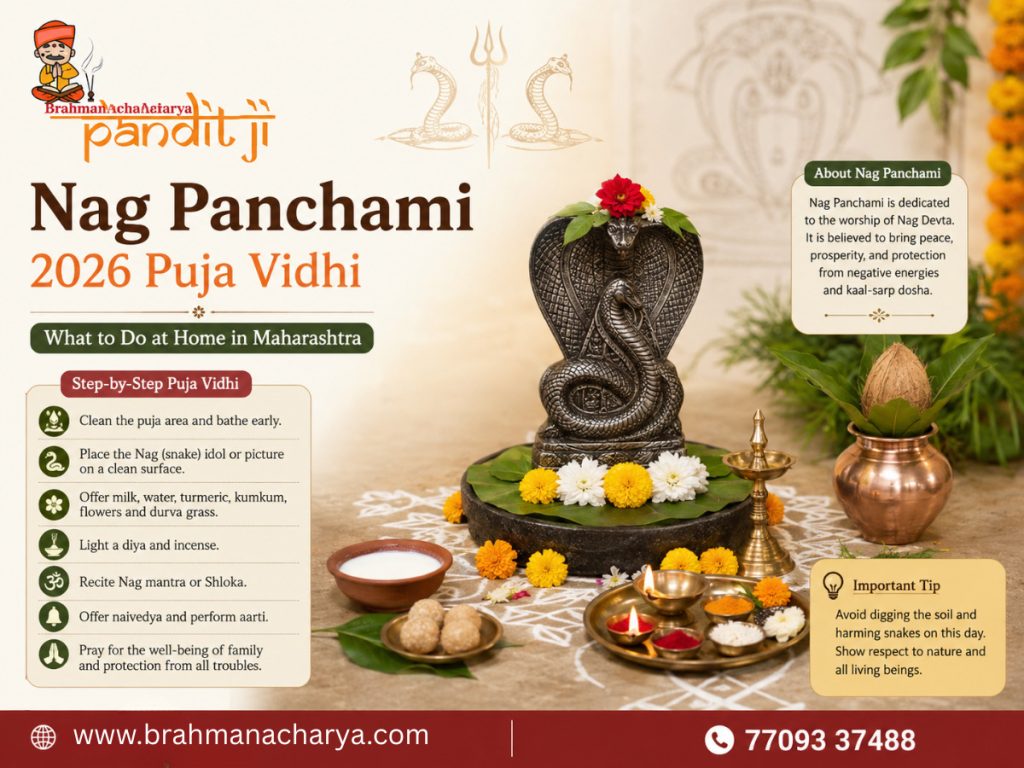
How to Perform nag panchami 2026 puja vidhi at Home: Step by Step
Unlike many other Hindu festivals, nag panchami 2026 puja vidhi does not strictly require a pandit and can be performed by any family member, most often the women of the household, following these steps. If you would prefer a pandit to conduct the puja with complete Vedic mantras, BrahmanAcharya can arrange one for you at home.
| Step | Ritual | How to Perform |
| 1 | Wake up early and take bath | Rise before sunrise, take a ritual bath, wear clean clothes |
| 2 | Draw the naga symbol | Using haldi and kumkum or sandalwood paste, draw two entwined snakes near the main entrance or puja room |
| 3 | Place a naga idol | Place a clay, silver or gold snake idol on a clean puja thali or wooden chowki |
| 4 | Offer milk | Pour unboiled milk in front of the idol or into a shallow clay vessel; the most important offering |
| 5 | Offer lahi | Place a handful of puffed rice in front of the idol |
| 6 | Offer flowers and durva | White flowers and durva grass are considered auspicious |
| 7 | Chant the Nag Panchami mantra | Recite the names of the five principal nagas |
| 8 | Light a deepak and agarbatti | Keep an oil or ghee lamp burning throughout the puja |
| 9 | Offer naivedyam | Place bananas, coconut and green grams (moong) as food offerings |
| 10 | Perform aarti | Wave the deepak in a circular motion before the idol while chanting |
| 11 | Distribute prasad | Share lahi, milk and fruit with all family members |
Nag panchami 2026 puja vidhi Do’s and Don’ts in Maharashtra
| Category | Do’s | Don’ts |
| Food | Eat sattvic food; consume milk-based preparations | Avoid fried food and non-vegetarian food |
| Soil | Keep the ground around your home undisturbed | Do not plough soil, dig earth or plant anything |
| Cooking | Cook without oil; prefer boiled or raw preparations | Do not cut vegetables with a knife or blade |
| Worship | Offer milk, lahi, flowers and durva to the naga | Do not offer fried items as naivedyam |
| General | Visit a naga temple if possible; pray for siblings’ welfare | Do not harm or disturb any snake, live or otherwise |
What Samagri Is Needed for nag panchami 2026 puja vidhi
- Milk, unboiled preferred, 250 ml in a clean vessel
- Lahi (puffed rice), 1 cup
- White flowers such as shevanti, jasmine or chameli
- Durva grass (trifoliate), 1 small bunch
- Coconut, 1
- Bananas, 2 to 4
- Green grams (soaked moong), 1 small bowl
- Haldi and kumkum, for the wall drawing and tilak
- Sandalwood paste (chandan), optional, for anointing the idol
- Clay or metal naga idol, 1, or draw on wall with paste
- Deepak and oil, 1, kept lit during puja
- Incense sticks (agarbatti), 1 packet
- Small copper or clay vessel, for the milk offering
Nag Panchami in Pune: Modern Adaptations
In Pune’s apartment living context, several traditional practices have been thoughtfully adapted for modern homes:
- Wall drawing: families draw the naga symbol on chart paper or use a printed naga image instead of a mud wall
- No live snakes: milk is offered to a clay or silver naga idol instead of a live cobra, which was a rural sapera tradition
- Simplified puja: many urban families complete a condensed 30 to 45 minute ritual without a pandit, focused on the milk offering, chant and aarti
- Temple visits: many Pune residents visit the Nagnath temple in Tulshibaug or Shiva temples that house naga idols on Nag Panchami morning
For families who want a more elaborate nag panchami 2026 puja vidhi with full Vedic mantras and Nag Stotra recitation, the experienced pandits at BrahmanAcharya specialise in nature-deity pujas and can guide the complete ritual at home.
Frequently Asked Questions
Q: When is Nag Panchami 2026 in Maharashtra?
A: Nag Panchami 2026 is on Thursday, 6 August. The Panchami tithi begins on the evening of 5 August and ends on the evening of 6 August, making 6 August the principal day of observance across Maharashtra.
Q: Is it safe to offer milk to a live snake on Nag Panchami?
A: Offering milk to live snakes is a traditional rural practice involving a professional sapera, and it is not recommended for urban households due to safety risks. Snakes also cannot digest milk the way mammals do. Using a clay or metal naga idol for the milk offering is the appropriate modern practice.
Q: Which nagas are worshipped on Nag Panchami?
A: The puja typically honours nine principal nagas, including Vasuki, Ananta, Shesha, Padmanabha, Kambala, Shankhapala, Dhritarashtra, Takshaka and Kaliya, recited as part of the Nag Panchami chant.
Q: Can I buy a Nag Panchami puja kit in Pune?
A: Yes. Most puja stores in Pune stock basic Nag Panchami kits around the festival, particularly in Kasba Peth, Budhwar Peth, Laxmi Road and neighbourhood stores across Wakad, Pimple Saudagar and Baner. A basic kit costs approximately INR 80 to 200 and includes haldi, kumkum, agarbatti, a printed naga image and a small clay vessel.
Q: What mantra is chanted on Nag Panchami?
A: The traditional chant recited in Maharashtra lists the nine principal nagas by name. A pandit can recite the fuller Nag Stotra for families who want a more elaborate puja.
Q: Does Nag Panchami require a full-day fast?
A: Fasting practices vary by family tradition. Some Maharashtra families observe a full fast, others eat once or consume only fruit and milk, and some simply avoid fried food. There is no single mandated rule; family elders or a pandit can guide you on your tradition’s specific practice.
Q: What happens if I miss the puja on the exact day?
A: If the ritual cannot be performed on 6 August itself, most families perform it as soon as possible within the Shravana month rather than skipping it entirely. A pandit can advise on an appropriate alternative date if needed.
Conclusion
Nag Panchami 2026 on 6 August is an important observance for Maharashtra households, connecting families to nature, tradition and protective deities. The home puja is simple, meaningful and requires no professional pandit for the basic ritual.
For families in Pune who want a full mantra puja or Nag Stotra recitation by a qualified pandit, BrahmanAcharya is happy to help. Simply book a puja online and let us know your requirement, and our team will arrange the right pandit for you.