
Table of Contents
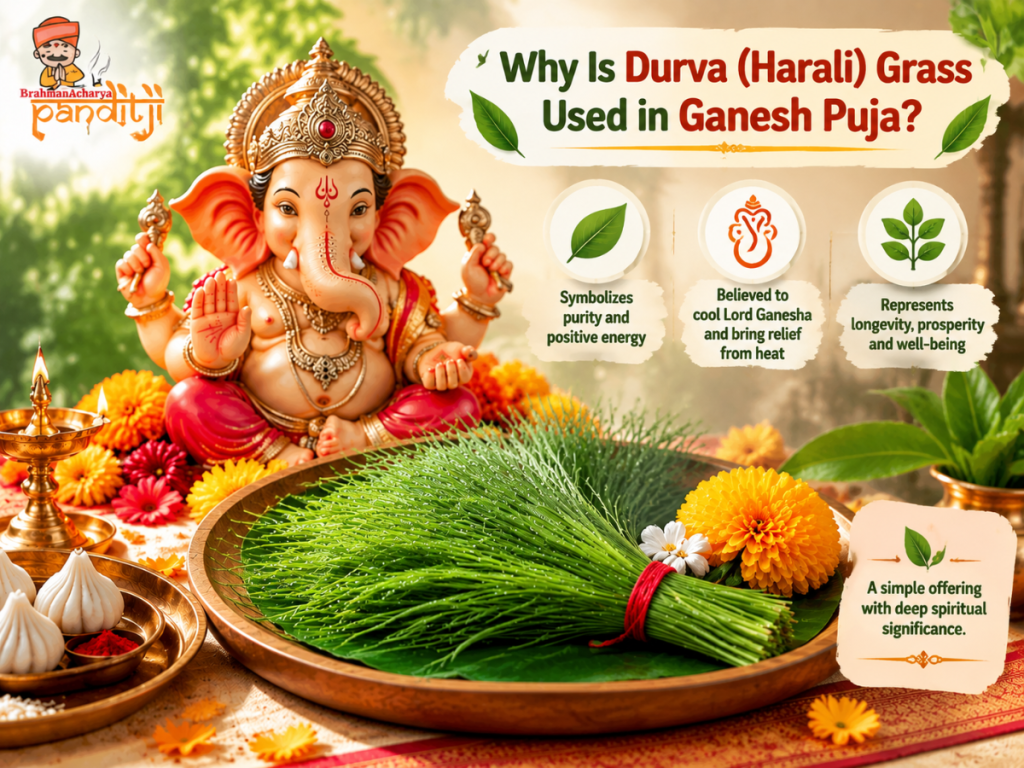
Why is durva grass used in Ganesh puja? Durva grass, called harali in Marathi, is considered Lord Ganesha’s single most favoured offering among the 21 patra, and the one leaf every Ganesh puja performed by our Pandit includes even when the rest are skipped. This guide covers the legend behind it, how many blades are traditionally offered, and the Ayurvedic properties often cited alongside its religious significance.
Quick Facts of Why is durva grass used in Ganesh Puja
- Botanical name: Cynodon dactylon
- Marathi name: Harali (हरळी), also called durva (दूर्वा)
- English names: Bermuda grass, Couch grass, Bahama grass
- Role in puja: widely regarded as Ganesha’s most favoured single offering among the 21 patra
- Traditional count: usually 21 blades or 21 pairs, sources vary, tied together and placed on the head, not the feet
- Ayurvedic profile: cooling (sheeta virya) and astringent (kashaya rasa), traditionally used for digestive, urinary and skin related purposes
Why Does Ganesha Prefer Durva Grass Over Other Offerings?
The legend behind durva traces to the demon Analasura, whose name means fire. Ganesha swallowed Analasura to protect the devas, and the demon’s fire began burning inside his stomach. Several gods tried to cool him without success – water from Varuna, a serpent from Shiva, the moon from Chandra, a lotus from Vishnu. A group of rishis performing a yagna nearby heard of his distress and brought 21 blades of durva grass tied into a bundle. The moment Ganesha accepted it, the burning stopped completely. This is the specific origin of durva’s place in his worship, a tradition that continues to be part of the traditional puja practices followed by families and priests today. The other 20 patra are offered as a broader devotional gesture rather than being tied to one defining legend.
How Many Durva Leaves Should Be Offered to Ganesha?
Guidance on the exact count varies slightly between sources. Some describe offering 21 individual blades, others describe 21 pairs tied together with a knot, for a total of 42 blades. Both versions agree on the core practice: an odd or symbolically complete number of durva blades, tied together rather than offered loose. One detail repeated consistently across sources is placement – durva is offered on Ganesha’s head, not at his feet, unlike most other flowers and leaves in the puja. These details are carefully followed when performing traditional Ganesh puja services, where each offering and ritual has its own significance.
What Are the Ayurvedic Benefits of Durva Grass?
Durva has a long standing place in Ayurveda independent of its religious use. It is described as cooling and astringent in classical texts, and is traditionally used for digestive complaints, urinary discomfort and certain skin conditions. This practical reputation is often mentioned as a secondary reason the plant was singled out from the wider list of 21 patra, alongside its role in the Analasura legend. The puja itself remains a devotional act, not a medicinal treatment.
Is Durva One of the 21 Leaves Offered During Ganesh Chaturthi?
Durva is one entry in the fuller list of 21 leaves offered during Ganesh Chaturthi, but it is the only one tied to a specific origin legend and the only one placed on the head rather than near the feet. Readers looking for the complete list, with botanical and Marathi names for all 21 leaves, can refer to the full patra list separately.
Frequently Asked Questions
What is durva grass called in Marathi?
It is called harali (हरळी) in Marathi, though the Sanskrit derived term durva (दूर्वा) is also widely used and understood.
Why is durva Ganesha’s favourite offering?
A legend describes Ganesha’s stomach burning after he swallowed the demon Analasura, and 21 blades of durva grass being the only offering that cooled it. This origin story is why durva holds a distinct place among the 21 patra.
How many durva blades should be offered to Ganesha?
Most guidance points to 21, though some describe this as 21 individual blades and others as 21 pairs tied together. Either way, the blades are tied in a bundle rather than offered loose.
Should durva be placed on Ganesha’s feet like other offerings?
No. Durva is traditionally placed on the head of the idol, which distinguishes it from most other flowers and leaves offered during the puja
Conclusion
Durva, known locally as harali, holds a distinct place among the 21 patra offered during Ganesh Chaturthi. Its significance comes from a specific legend rather than general devotional practice, and the details around it, how many blades are offered and where they are placed, are followed more precisely than with any other leaf on the list. Getting this one right keeps the core of the ritual intact even on years when the rest of the 21 patra are hard to gather in full. For help sourcing the remaining leaves or booking a pandit who knows the complete puja vidhi, call Brahman Acharya or reach out us.